






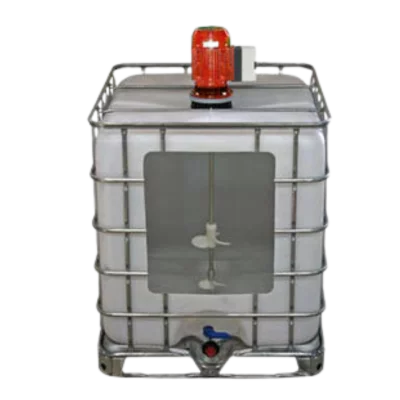
IBC-Mixer
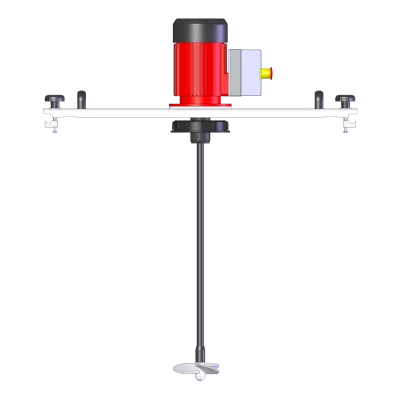
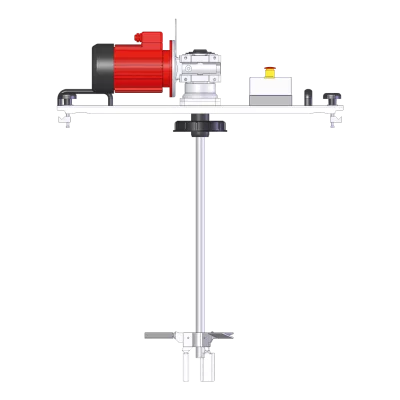
FLUX mixers agitate, mix, and homogenize liquid media in tanks ranging from 30 to 30,000 liters. Depending on the application, the motor, shaft, and mixing blades can be configured to suit the medium, viscosity, and tank. This results in solutions for consistent mixing processes, high circulation rates, and defined flow conditions.
Overview
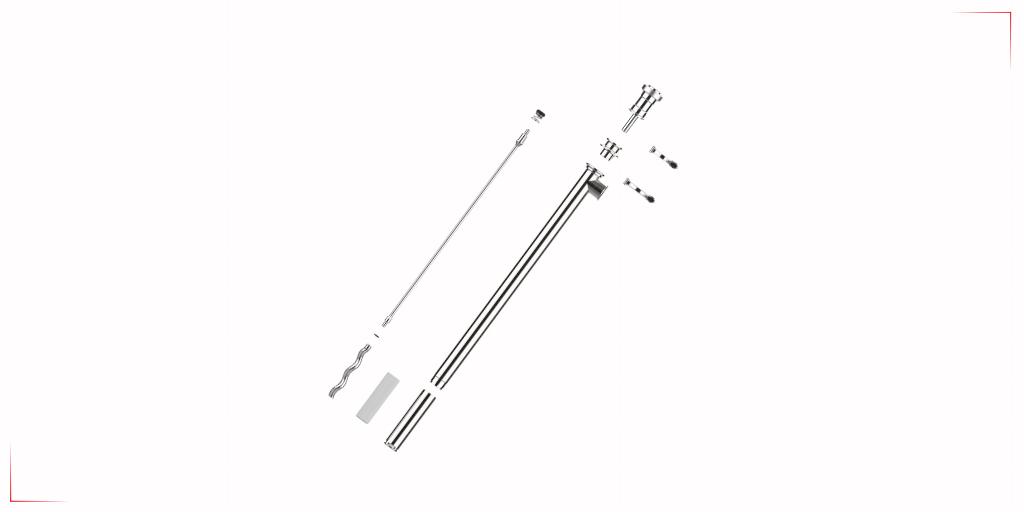
The FLUX mixer series features a modular design. The motor, shaft, and mixing blades can be tailored to the specific process. The mixer shafts are available in lengths ranging from 150 to 1,800 mm. Depending on the medium, models are available in stainless steel or with a PVDF or PE coating.
Fast Runner
For low- to medium-viscosity media
High-speed FLUX mixers are designed for low- to medium-viscosity media and smaller containers. They operate at speeds ranging from 750 to 1,500 min⁻¹ and achieve circulation rates of up to 650 m³/h.
If necessary, multiple mixing blades can be mounted one above the other on the shaft. This allows the mixing effect to be adapted to the medium, fill level, and container shape. High-speed mixers are particularly suitable for IBCs and tanks up to approximately 4,000 liters.
Suitable for:
- Containers from 30 to approximately 4,000 liters
- Circulation rates up to 650 m³/h
- Rotational speeds from 750 to 1,500 min⁻¹
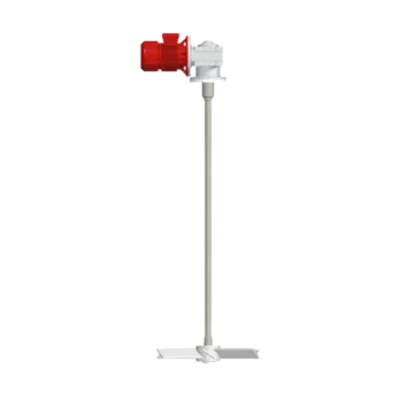
Slow Runner
For high circulation rates
Low-speed FLUX mixers are suitable for applications requiring high circulation rates and controlled flow. They operate at low speeds starting at approximately 70 min⁻¹ and are designed for fluids up to 10,000 mPas.
The integrated gearbox allows even large volumes of liquid to be moved reliably. Depending on the model, sliding or retractable agitators are available. This facilitates use in tanks and larger containers.
Suitable for:
- Containers up to 30,000 liters
- Circulation rates up to approx. 3,600 m³/h
- Fluids up to 10,000 mPas
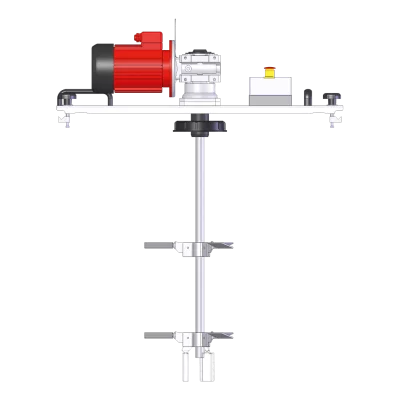
IBC-Mischersets
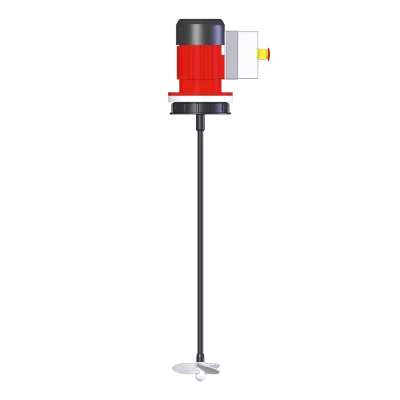
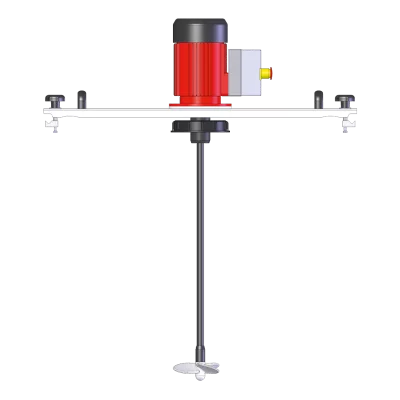
IBC-Mischersets für das zuverlässige Mischen und Homogenisieren unterschiedlich viskoser Medien. Verschiedene Motorleistungen und Mischflügel decken ein breites Anwendungsspektrum ab.
- Für Medien bis 12.000 mPas
- Varianten für unterschiedliche Mischaufgaben
- Komplett montiert und direkt einsetzbar
Mixer Comparison
An overview of the most important specifications and features—for selection and comparison.
The FLUX modular system enables process-specific design. Drive motors compliant with IEC standards, various shaft lengths, and suitable materials form the basis. The selection of the mixing blade depends on the medium, the application, and the desired flow pattern. This allows mixers to be configured for chemical, industrial, and process engineering applications. The components are not considered in isolation, but rather as a functional system.
| Feature | Fast runner | Slow runner |
|---|---|---|
| Application | For low- to medium-viscosity media and smaller containers | For high circulation rates and larger containers |
| Tank sizes | 30 to approx. 4,000 L | 30 to 30,000 l |
| Circulation capacity | up to 650 m³/h | up to approx. 3,600 m³/h |
| Speed | 750 to 1,500 min⁻¹ | from approx. 70 min⁻¹ |
| Viscosity | Low- to medium-viscosity fluids | up to 10,000 mPas |
| Solid content | up to 5% | up to 10% |
| Drive | Motors compliant with IEC standards | Motors compliant with IEC standards, with gearboxes |
| Shaft lengths | 150 to 1,800 mm | 150 to 1,800 mm |
| Materials | Stainless steel, PVDF, PE | Stainless steel, PVDF, PE |
| Mixing blades | Multiple mixing blades stacked on top of each other are possible | Sliding or retractable agitator possible |
| Use in continuous-flow systems | 5- to 20-fold throughput per hour | 10- to 40-fold throughput per hour |
| Ideal for | IBCs and tanks up to approx. 4,000 L | Tanks and larger containers |
The maximum flow rate is a test bench value, measured with water at 20 °C at the pump’s discharge port, without accessories (hose, dispensing nozzle, flow meter). The flow rate that can be achieved in practice is lower and depends on the specific application, the properties of the fluid, and the pump configuration. Specifications are for an axial rotor, unless otherwise stated.
Mixer Sets
FLUX mixer sets for industrial applications: modular design for media up to 12,000 mPas.
Get in touch.
Find documents.

Sales & Advice
Select a pump suitable for the application
We determine the medium, flow rate, viscosity and operating environment.

Requests for quotations
Please send us your requirements
We will assess your requirements and advise you on the most suitable option.

Service & Support
Documents for planning, operation and servicing
Find user manuals, dimension sheets, technical specifications and FAQs.