








What Matters When Mixing
Four factors that are crucial when designing a mixing solution.

Circulation Capacity
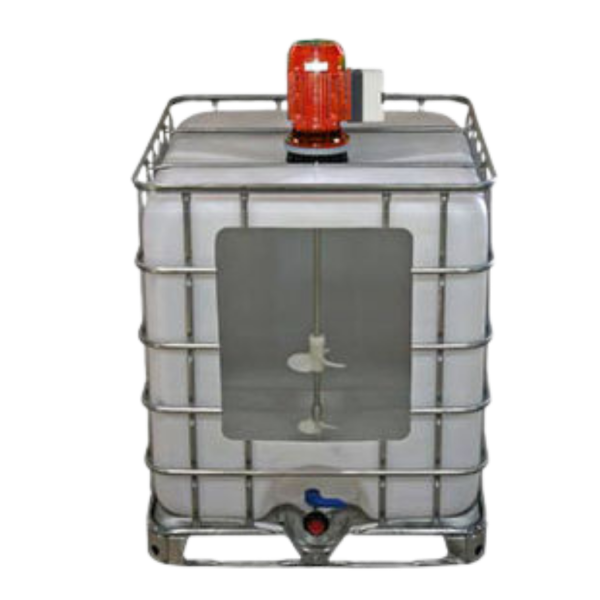
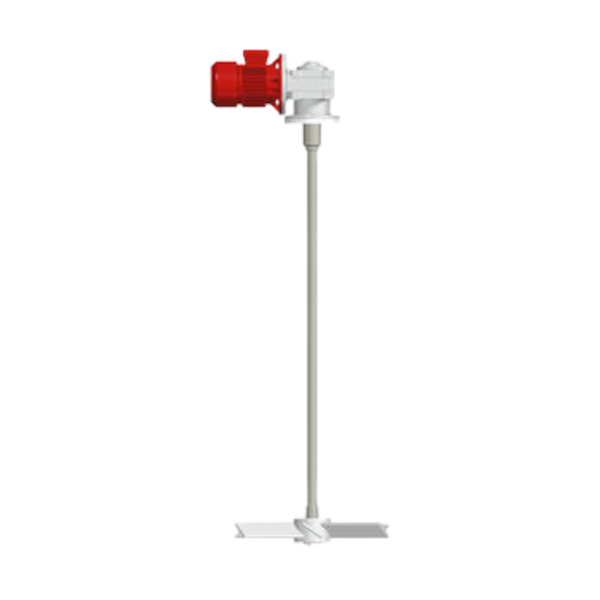
Up to 650 m³/h for the high-speed model (5- to 20-fold hourly throughput) Up to 3,600 m³/h for the low-speed model (10- to 40-fold hourly throughput) Design based on tank volume × required circulation rate

Viscosity range
High-speed mixers up to 2,500 mPas (750–1,500 min⁻¹) Slow-speed mixers with gearboxes up to 10,000–12,000 mPas (approx. 70 min⁻¹) Solid content up to 5% (high-speed mixers) or 10% (slow-speed mixers)

Container Size & Mounting
IBCs and tanks up to 4,000 l (high-speed models) Tanks up to 30,000 l and continuous-flow systems (low-speed models) Clamping device or adapter flange, sliding/folding agitator

Materials & Chemical Resistance
Mixing impellers and shafts made of PP, PVDF, and stainless steel Material selection based on the resistance list, not on viscosity F 426 S mixing drum pump (stainless steel) ATEX II 1/2 G c IIB T4

Mixing: Methods Compared
The key features of the three FLUX mixing solutions at a glance – for selection and comparison.
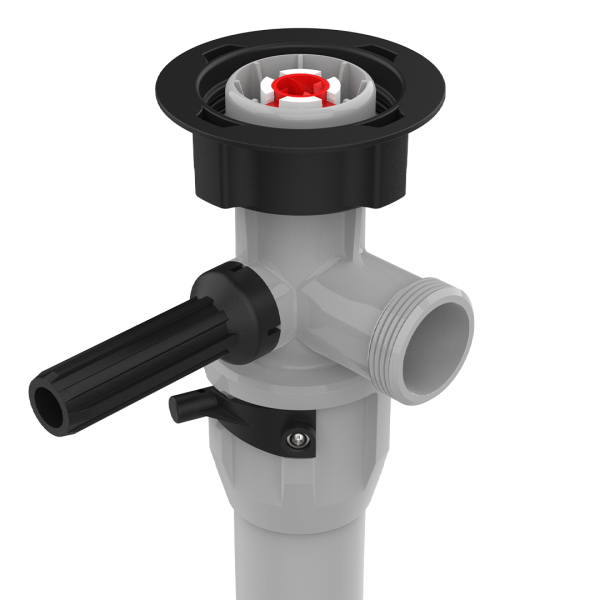
| Feature | High-speed agitator | Low-speed agitator | Mixing drum pump F 426 |
|---|---|---|---|
 |
 |
 |
|
| Max. circulation capacity | 650 m³/h | 3,600 m³/h | – |
| Max. flow rate | – | – | 240 l/min |
| Speed | 750–1,500 min⁻¹ | approx. 70 min⁻¹ | Depending on motor |
| Max. viscosity | 2,500 mPas | 10,000–12,000 mPas | 1,200 mPas |
| Max. solids content | 5 % | 10 % | – (inhomogeneous media) |
| Gearbox | – | ✓ | – |
| Container / vessel | IBCs, tanks up to 4,000 l | Tanks up to 30,000 l, inline systems | Canisters, drums (200 l), IBC |
| Mixing impeller | Multiple stages stackable | Sliding / foldable | Integrated in pump tube |
| Mixing + transfer in one operation | – | – | ✓ (diverter lever) |
| Explosion protection | – | – | ✓ F 426 S (II 1/2 G c IIB T4) |
| Ideal for | Low-viscosity, smaller vessels | High-viscosity, large tanks | Mixing directly in the drum while pumping |
| View Products | View Products |
View Product |
All specifications subject to configuration, medium and motor. Flow values are test bench values (water, 20 °C) – the practically achievable flow rate is application-dependently lower. See the respective data sheet for details. For highly viscous or shear-sensitive media (fats, pastes, concentrates), eccentric screw pumps (VISCOFLUX, VISCOPOWER) complement the range.
Case Studies
Real-World Examples: How Customers Use FLUX Systems for Mixing.
Blending and Filling of Coolant Lubricants
F 426, F 457-1 EL – Homogenize emulsions and fill them into machine tanks.
Filling and Mixing Pesticides
F 426 Drum Pump, F 457 Collector Motor – Mix directly in the drum and then fill containers.
Mixing and Pumping Low-Viscosity Oils
MINIFLUX Sanitary – Hygiene-compliant pumping with a mixing effect.
Mixing in Various Industries
Mixing tasks vary greatly depending on the medium and container—speed, material, and mounting must be suited to the industry.

Chemistry
Aluminum sulfate, iron chloride, and aqueous solutions in IBCs and tanks—high-speed mixers for thorough mixing.

Water and Wastewater
Lime-milk mixtures, flocculants, and polymer solutions in wastewater treatment plant tanks—low-speed pumps with high circulation capacity.
Industry & Metalworking Fluids
Homogenize emulsions and fill them into machine tanks—F 426 or high-speed mixers for mixing tanks.

Agriculture
Mixing and filling pesticides and animal attractants – F 426 with F 457 collector motor.

Paints & Lacquers
Mix and pump out paints, inks, and pigment pastes directly from the drum – F 426 with control lever, explosion-proof version for solvents.

Surface Technology
Circulate rinse baths and additives without dead zones—in tanks and continuous-flow systems.
Frequently Asked Questions About Mixing
The design is based on three factors: tank volume, viscosity, and the desired circulation rate (how often the tank volume should be completely mixed per hour). High-speed pumps achieve a throughput of 5 to 20 times the hourly volume, while low-speed pumps achieve 10 to 40 times the hourly volume. Rule of thumb: For homogeneous mixing of low-viscosity media, a throughput of 5 times the hourly volume is sufficient; for viscous media or to prevent sedimentation, at least 20 times the hourly volume is required. For complex media or continuous-flow systems, a project-specific design is recommended.
The F 426 is a drum pump with a control lever that combines mixing and pumping in a single operation: In mixing mode, it homogenizes the medium in the drum; when the control lever is flipped, it switches to pumping mode without stopping and begins dispensing immediately. It is the right choice when a medium needs to be homogenized immediately before dispensing—typically for paints, coatings, and two-phase mixtures from a 200-liter drum. Flow rate up to 240 l/min, viscosity up to 1,200 mPas. For stationary mixing in IBCs or tanks, a high-speed or low-speed mixer is more efficient.
Mixing impellers, shafts, and pump components are available in PP, PVDF, and stainless steel. The choice of material depends on chemical resistance to the medium—not on viscosity. Refer to the FLUX Compatibility List for guidance. For aggressive media (e.g., strong alkalis), PP or PVDF is often a better choice than stainless steel; for flammable solvents in hazardous areas, ATEX-certified stainless steel is mandatory (e.g., F 426 S, II 1/2 G c IIB T4). Using the wrong material poses a risk of breakage and a safety hazard.
For highly viscous media containing solids—such as lime milk, flocculants, or sludge suspensions—the circulation rate is critical: It must be high enough to keep the particles in suspension, but low enough not to disrupt floc structures. The low-speed agitator, operating at approximately 70 min⁻¹ and with a circulation capacity of up to 3,600 m³/h, meets both requirements. For continuous operation (e.g., wastewater treatment plants), it offers lower wear and energy consumption compared to high-speed agitators. Adjustable or retractable agitators allow adaptation to changing liquid levels.
Get in touch.
Find documents.

Sales & Advice
Select a pump suitable for the application
We determine the medium, flow rate, viscosity and operating environment.

Requests for quotations
Please send us your requirements
We will assess your requirements and advise you on the most suitable option.

Service & Support
Documents for planning, operation and servicing
Find user manuals, dimension sheets, technical specifications and FAQs.