







What Matters When Emptying
Five design factors determine the choice of method—regardless of industry or medium.

Energy Supply
- Mains Power: Series 400 Drum Pump with Electric Motor
- Compressed air (4–7 bar): RFM/FDM compressed-air diaphragm pump
- Cordless: FBM 4100 battery-powered pump set, COMBIFLUX with FBM-B 3100

Mobility
- Stationary: Workshop, equipment, or tank emptying
- Mobile: Service vehicle, outdoor facilities, emergency drainage
- Battery kits can be used anywhere without cables or compressed air hoses

Viscosity range
- Up to approx. 1,200 mPas: Drum pump (water, acids/alkalis, solvents)
- Up to 15,000 mPas: Pneumatic diaphragm pump
- Higher: Eccentric screw pump (see residual drainage)

Material Compatibility
- PP, PVDF, stainless steel, Hastelloy C, aluminum (as per the compatibility list)
- Highly corrosive acids: seal-less pumps (F 424)
- Food: FOOD-grade materials in accordance with EC 1935/2004 + EU 10/2011

Safety & Explosion Protection
- ATEX certification in accordance with Directive 2014/34/EU for flammable media
- Stainless steel/Hastelloy Ex versions: FP 425 Ex S, F 460 Ex
- Battery-powered motors are generally not ATEX-certified


Solutions at a Glance
Standard immersion depths for drum pumps and cordless pump sets by container type—as a guide for configuration.
| Container Type | Typical Volume | Standard Immersion Depth | Recommended Products |
| Canister | 5–60 L | approx. 300–500 mm | |
| Small containers (bottles, buckets, hobbocks) | 1–60 l | approx. 300–500 mm | |
| Drum (200 l) | 200 l | approx. 1,000 mm | |
| IBC | 1,000 L | approx. 1,200 mm | |
| Large containers / tanks | > 1,000 L | Custom lengths up to approx. 3,000 mm |
Case Studies
Practical Examples: How customers use FLUX systems to empty drums, IBCs, canisters, and tanks.
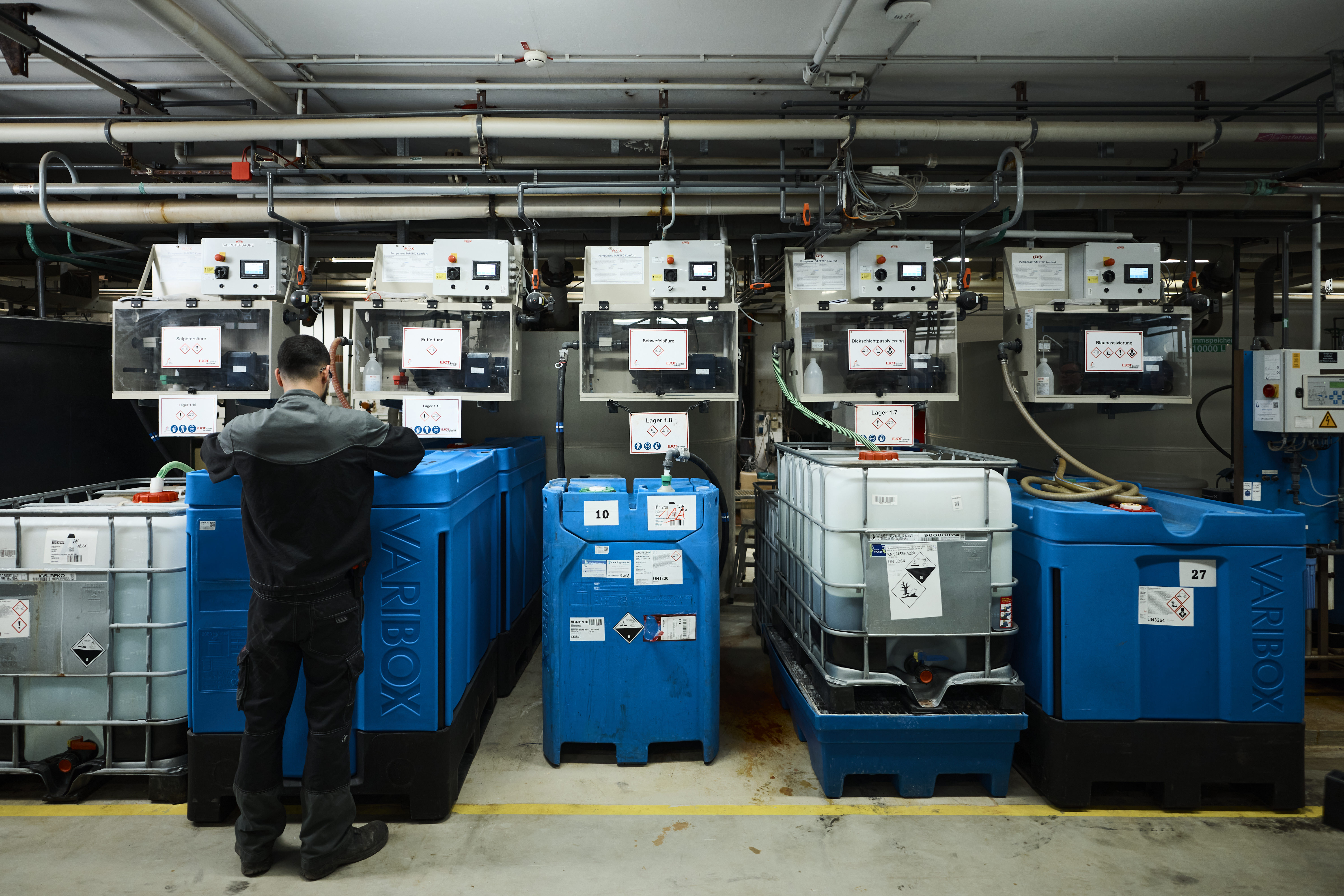
Emptying Ethanol Drums in a Hazardous Area
FP 425 Ex S, F 460 Ex, FMC 100 – ATEX kit for the safe emptying of ethanol drums in cosmetics production.
Emptying Mobile Caustic Soda Canisters into Degreasing Baths
COMBIFLUX FP 314 (PP), FBM-B 3100 – Empty caustic solutions from canisters directly into electroplating tanks without a seal.
Emptying high-viscosity fruit juice concentrate from IBCs
VISCOPOWER F 570 – Gently empty viscous concentrates (up to 80,000 mPas) from the 1,000-liter IBC, leaving minimal residue.
Pumping Electroplating Wastewater Out of Collection Tanks
F 640 PP Submersible Centrifugal Pump – stationary tank drainage, resistant to aggressive electroplating solutions.
Discharging in Various Industries
Discharge tasks vary depending on the medium, container, mobility requirements, and safety class—the choice of pump, materials, and certification must be appropriate for the industry.
Industry
Lubricating oils, cooling lubricants, industrial greases, hydraulic fluids, and adhesives from drums and IBCs – Series 400 drum pumps in standard operation, FBM 4100 mobile for service applications, explosion protection for flammable media (e.g., test gasoline, solvents).
Chemistry
Safely drain acids, alkalis, and solvents from IBCs and drums with minimal residue—material selection based on the compatibility list (e.g., PP, PVDF, stainless steel, Hastelloy C); ATEX compliance with Directive 2014/34/EU for flammable media.

Food & Beverage
Tomato paste, fruit juice concentrates, cocoa butter, and light oils—compliant with EC 1935/2004, EU 10/2011, FDA CFR 21, and 3-A; with the FLUX FOOD series.

Pharmacy
FDA-compliant small-batch filling—APIs, suspensions, creams.

Cosmetics
Ethanol, fragrance oils, glycerin, cleaning oils, and healing clay – explosion protection for alcohol-based media (ATEX), stainless steel for purity, and a cordless pump set for mobile applications.

Water & Wastewater
Acidic wastewater from collection tanks, condensate in the digestion tower (Ex), media containing solids, and abrasive slurries – F 640 PP submersible centrifugal pump, F 430 with F 460-1 Ex motor, FHP peristaltic pump for abrasive slurries, RFM/FDM compressed-air diaphragm pumps.
Surface Technology
Sodium hydroxide solution from canisters into degreasing baths, electroplating and pickling solutions from collection tanks – COMBIFLUX in PP/PVDF, F 424 seal-less in PVDF for highly corrosive acids (e.g., chromic acid), Series 600 submersible centrifugal pump (F 640) for stationary tank emptying.
Frequently Asked Questions About Emptying
“Emptying” is the generic function: every drum, every IBC, every canister, and every tank is emptied using the appropriate pump. As long as the medium is low- to medium-viscosity and the residual amount remaining in the drum is not a major concern, a standard drum pump, a pneumatic diaphragm pump, or a cordless pump set is sufficient.
“Residual emptying” is the specialized function focused on minimizing the residual quantity (less than 1% in an ISO-lidded drum)—relevant for highly viscous or paste-like media such as lubricating greases, tomato paste, petroleum jelly, or adhesives. This is where VISCOFLUX systems with the “following plate” principle come into play: a flexible process seal rests on the surface of the medium and follows the falling liquid level.
Rule of thumb: If the material value per liter is high (pharmaceuticals, adhesives, cosmetics), if cleaning or disposal costs apply, or if the medium has a viscosity of > 15,000 mPas, you should choose residual drainage.
The FBM 4100 cordless pump set can empty approximately 28 drums (200 l) or 5 IBCs (1,000 l) per battery charge—based on water at 20 °C. The brushless 420-W motor empties a 200-l drum filled with water in under a minute. The package includes two Sealed PXC Plus batteries, each with a capacity of 4.0 Ah, allowing for virtually continuous operation using a battery-swapping system.
The actual runtime depends on the fluid, viscosity, speed, and selected pump—with viscous fluids, the number of cycles per charge decreases accordingly. IP 24 (vented) or IP 44 (enclosed) protection, dry-run protection, and an LCD display with real-time readings are standard features.
No—the FBM 4100 battery-powered motor is not ATEX-certified. There are two alternative methods for draining flammable or potentially explosive media (ethanol, solvents, fuels, flavorings):
- Drum pump with F 460 Ex collector motor (II 2 G Ex db eb IIC T6/T5 Gb) – electrically powered, ATEX-compliant per Directive 2014/34/EU, suitable for use in stainless steel or Hastelloy C pumps.
- RFM/FDM compressed-air diaphragm pump in ATEX design – compressed-air driven, no power connection required, self-priming up to 4.5 m dry.
Both variants enable mobile Ex drainage in locations where the battery-powered pump set cannot be used.
The choice of material is based on the compatibility list—relevant standard materials are:
- PP (polypropylene): acids, alkalis, salt solutions, many cleaning agents
- PVDF (polyvinylidene fluoride): Highly concentrated acids (e.g., 60% nitric acid), solvents
- Stainless steel 1.4571 / 1.4404: Food, pharmaceuticals, oxidizing acids at higher temperatures, solvents
- Hastelloy C: Highly aggressive media, chlorine compounds, high temperatures
- ETFE / SiC: Special materials for hermetically sealed MAGSON pumps, very high resistance
For highly corrosive acids (e.g., chromic acid), seal-less pumps such as the F 424 in PVDF with a titanium shaft or the COMBIFLUX FP 314 in PP/PVDF with a rechargeable motor (for mobile canister/drum emptying) are preferred. For oxidizing media, always pay attention to the O-ring and shaft materials—standard versions use FKM or FFKM (Kalrez®). FLUX provides specific material recommendations following a media analysis.
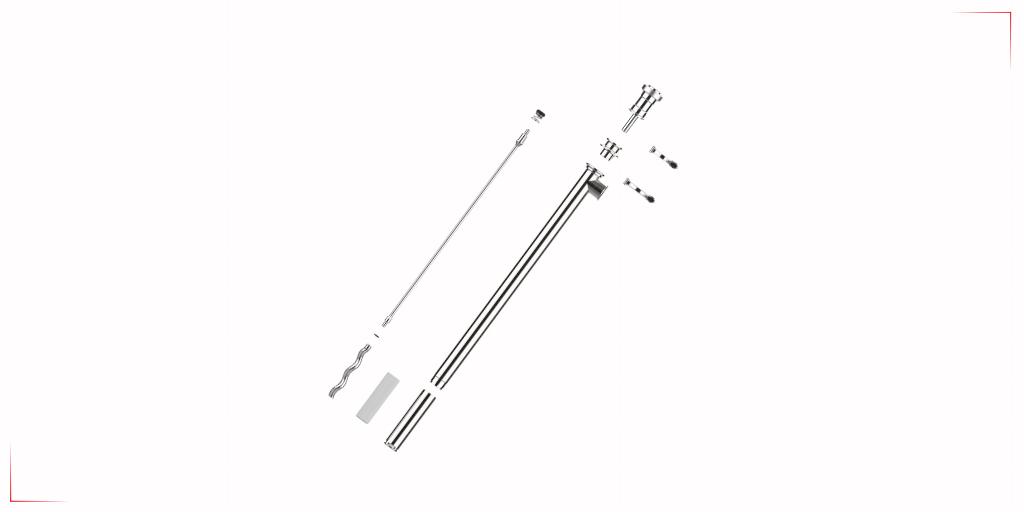
The 400 Series drum pump is the standard solution for drums, IBCs, and canisters with immersion depths of 700–1,000–1,200 mm (custom lengths up to 3,000 mm). It is modular, easy to replace, and optimized for mobile to semi-stationary applications.
The 600 Series submersible centrifugal pumps (e.g., F 640) are used when:
- the container is taller than 1,500 mm (600 Series with immersion depths up to 4,100 mm)
- high flow rates are required (600 Series up to 42 m³/h, 700 Series up to 74 m³/h)
- continuous operation is required (700 Series specifically designed for stationary circulation and filtration tasks)
- media containing solids (e.g., slurries, electroplating wastewater) are being pumped—the 600 Series is designed for this
Submersible centrifugal pumps are installed in stationary or semi-mobile configurations—not intended for quick container changes. The 600 Series (F 640 PP/PVDF) is the standard solution for draining acidic wastewater from collection tanks or for pumping in electroplating baths. For abrasive slurries and sewage sludge, the FLUX-FHP peristaltic pump rounds out the product line.
Get in touch.
Find documents.

Sales & Advice
Select a pump suitable for the application
We determine the medium, flow rate, viscosity and operating environment.

Requests for quotations
Please send us your requirements
We will assess your requirements and advise you on the most suitable option.

Service & Support
Documents for planning, operation and servicing
Find user manuals, dimension sheets, technical specifications and FAQs.