






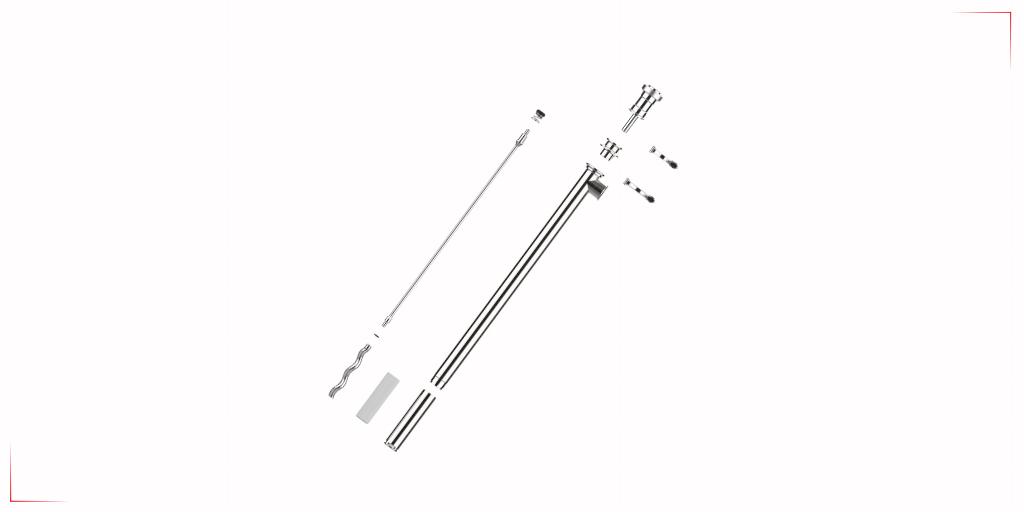

With a mechanical seal:
In the JUNIORFLUX F 310, the mechanical seal seals the inner tube against the fluid. It thus prevents the fluid from entering the inner tube. The shaft only comes into contact with the fluid in the rotor area.
On the F/FP 425, turning the control lever – even whilst the motor is running – closes the non-return valve at the base of the pump. This ensures that the fluid remains in the pump and does not flow back into the tank.
(Non-return valve open vs. non-return valve closed)
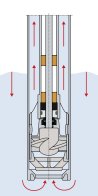
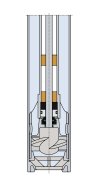
On the F 426 mixing pump, the mixing orifices can be opened or closed by turning the two control levers. This allows the mixing or mixing/delivery process to be switched to a pure pumping operation, even whilst the engine is running.
(Mixing vs Pumping)
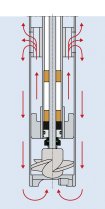
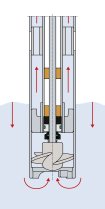
In the F/FP 430, the mechanical seal seals the inner tube against the medium. This prevents the medium from entering the inner tube. The shaft comes into contact with the medium only in the rotor area.
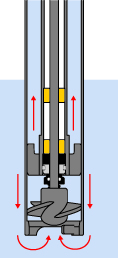
The F 430 PP 100/50 operates on the principle of a conventional submersible centrifugal pump. The fluid enters through the opening in the pump casing and is conveyed to the pump’s discharge port by the rotation of the impeller.
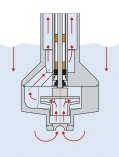
In the F 430 TR, the mechanical seal seals the inner tube against the fluid. It thus prevents the fluid from entering the inner tube. The shaft only comes into contact with the fluid in the rotor area.
The MINIFLUX operates on the principle of an axially acting centrifugal pump. Its mechanical seal and a radial shaft seal seal off the fluid area from the pump’s drive. As a result, the shaft only comes into contact with the fluid in the rotor area.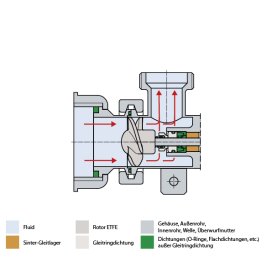
Seal-free in liquid applications:
In the seal-less drum pumps JUNIORFLUX F 314 and COMBIFLUX FP 314, the fluid is conveyed from the rotor to the discharge connection. Inside the inner tube, the fluid remains at the same level as in the container. During emptying, it flows back out via the relief openings.
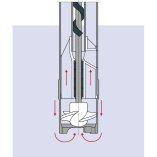
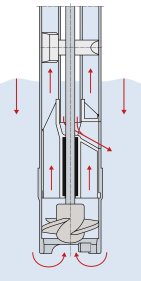
In the F/FP 424 seal-less drum pumps, the fluid flows along the shaft and into the inner tube. There, it is at the same level as in the drum. As the drum is emptied, the fluid level in the drum drops. The fluid level in the inner tube drops accordingly. The fluid inside the inner tube then drains out through the relief openings.
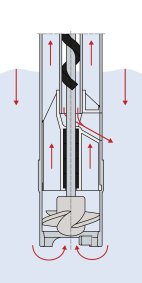
With the F/FP 427 drum pump, which has no seals in the liquid-carrying section, the fluid also flows along the shaft into the inner tube. There, it is at the same level as in the drum. As the drum is emptied, the fluid level in the drum drops. The fluid level in the inner tube drops accordingly. The fluid inside the inner tube then flows out through the relief openings.
Get in touch.
Find documents.

Sales & Advice
Select a pump suitable for the application
We determine the medium, flow rate, viscosity and operating environment.

Requests for quotations
Please send us your requirements
We will assess your requirements and advise you on the most suitable option.

Service & Support
Documents for planning, operation and servicing
Find user manuals, dimension sheets, technical specifications and FAQs.