


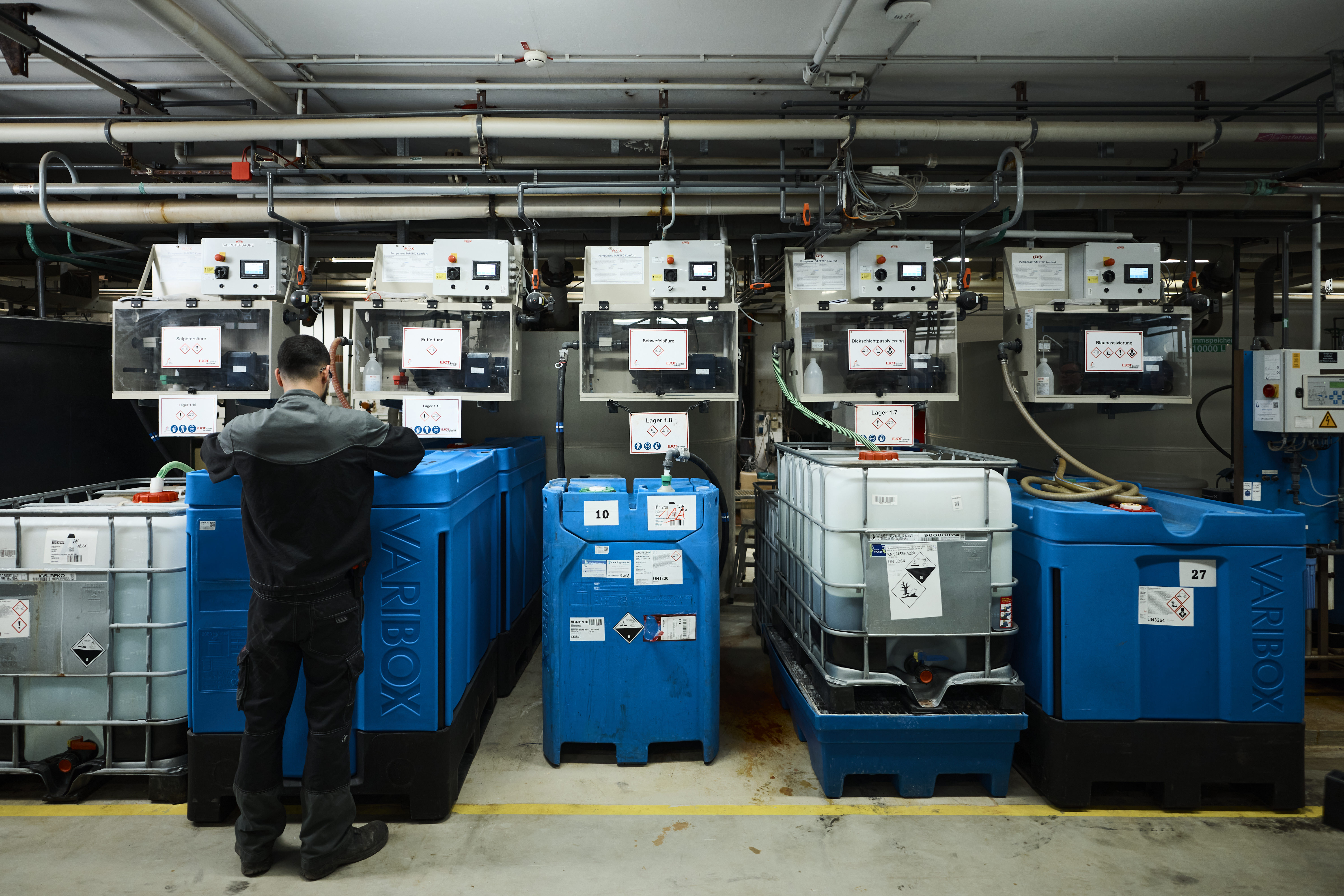






Flow Meters

Flow meters and flow counters are used wherever liquids need to be precisely measured, dispensed, or filled.
FLUX flow meters operate on the wobble-disc, oval wheel, or turbine wheel principles and cover flow rates from 0.04 to 380 l/min at viscosities up to 500,000 mPas—whether used as portable units on drum pumps or as stationary units in piping systems.




Advantages

Precise Measurement of High-Viscosity Liquids
Up to 500,000 mPas—reliably measures bitumen, resins, and high-viscosity oils as well.

Measure regardless of position
Works in any installation position—horizontal, vertical, or at an angle—without the need for readjustment.

Semi-automatic dosing
Fill preprogrammed quantities at the push of a button—with signals sent to valves and the PLC.

Portable and easy to handle
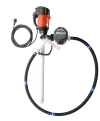
Mechanical counting unit attached directly to the JUNIORFLUX/COMBIFLUX – 0.24 kg, ready for immediate use.
Applications
Typical Applications and Areas of Use for FLUX Flow Meters
Small-Volume Dosing
Filling small quantities from canisters and drums—on the go with JUNIORFLUX/COMBIFLUX and FMT.
High-viscosity fluids
Oils, resins, bitumen up to 500,000 mPas – FMO oval wheel flowmeter, even with pulsating flow.
Semi-automatic filling
Preprogrammed target quantities at the push of a button – FLUXTRONIC® with signal output to valves and PLC.
Ex-protected measurement
Flammable media and solvents – FMC and FMO in explosion-proof versions.
On-site equipment measurement
In-line measurement in piping systems – FMO for pressures up to 200 bar, low pressure loss.
Food & Pharmaceuticals
FDA- and FOOD-compliant designs—for safe dosing in hygiene-sensitive areas.


Measurement Principles and Recommended Applications
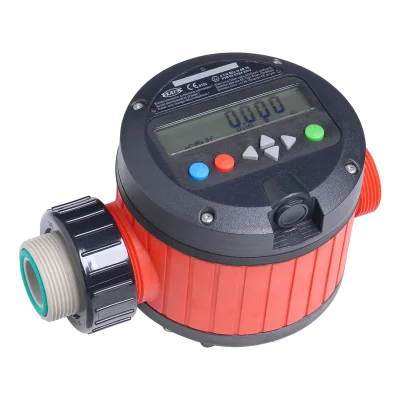
Low- to medium-viscosity fluids (up to 2,500 mPas), including those with light contamination. Mobile use with drum pumps and container pumps from the 400 series, or stationary use in plant engineering. FMC models are suitable for batch operation; FMJ models are only suitable for normal operation (no automatic operation).
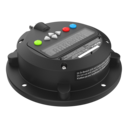
The FMC/FMJ series flow meters operate on the swivel disc principle. In this system, the flow sets the swivel disc in motion. The FLUXTRONIC® evaluation unit calculates the volume dispensed based on the number of rotations. For maximum measurement accuracy, the system must always be completely filled with flow or liquid.
- The FMC/FMJ flow meters are primarily used with our Series 400 drum pumps and container pumps
- They are also suitable for stationary use in plant engineering
- The FMJ should only be used if batch operation (automatic filling at the push of a button) is not required
- FMC flow meters are also suitable for batch operation (automatic operation)
- Also suitable for measurements in hazardous areas
- For applications involving low-viscosity liquid media such as acids, alkalis, fuels (gasoline, diesel), water, oils, highly flammable media, solvents, and even slightly contaminated liquids
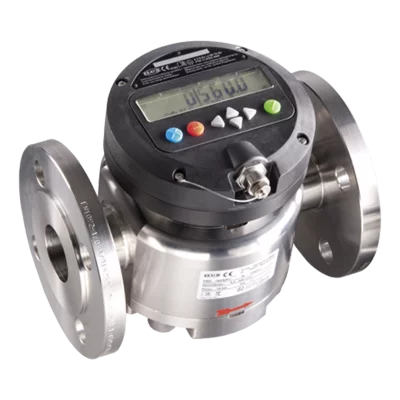
Wide viscosity range (up to 500,000 mPas), even with pulsating flow rates (compressed-air diaphragm pumps). Mobile use with drum, container, and eccentric screw pumps, or stationary use in plants. Sizes FMO 101/102 for small flow rates, FMO 104/110 for medium flow rates, and FMO 140/150 for large flow rates.
The flow meters of the FMO series consist of a measuring chamber with oval wheels. The medium flows through the measuring chamber, thereby driving the oval wheels. A reed sensor counts the number of revolutions made during this process and transmits this data to the FLUXTRONIC®. The FLUXTRONIC® calculates the flow rate of the medium based on a previously entered, medium-specific calibration constant.
- FMO 101 and FMO 102 for low flow rates
- The FMO 104 and FMO 110 are primarily used with our drum pumps, container pumps, and eccentric screw pumps
- The FMO 140 and 150 are primarily used in larger systems
- The FMO units are suitable for automatic filling (batch operation) of fluids at the push of a button
- For applications and liquids in hazardous areas
- Also available with FDA/FOOD certification
- For pure and highly viscous liquids, such as acids, alkalis, fuels (gasoline, diesel), water, oils, solvents, highly flammable media, and non-self-lubricating media
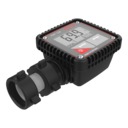
Low-viscosity, non-flammable fluids (up to 40 mPas). Purely mechanical metering unit, specifically designed for mobile use with JUNIORFLUX/COMBIFLUX pumps. Cost-effective alternative to FMC/FMJ.
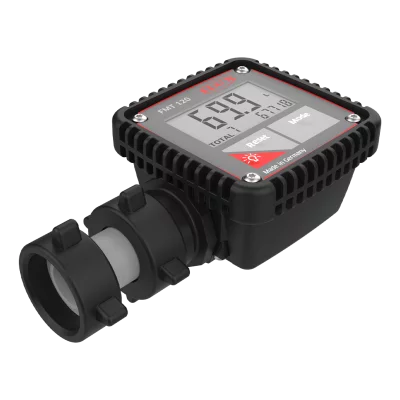
Flow meters and flow meters of the FMT series based on the turbine wheel principle:
The FMT 120 PP flow meter operates according to the turbine wheel principle. It uses a turbine measuring wheel that rotates freely in the liquid flow. The medium flowing through the flow meter sets the turbine impeller in rotational motion, which is measured and evaluated. The partial and total volumes are displayed on the five-digit LCD screen.
- The FMT flow meter is primarily used with our JUNIORFLUX/COMBIFLUX drum pumps for smaller flow rates and filling volumes
- An affordable alternative to our FMC/FMJ flow meters and flow counters
- For neutral, low-viscosity, and non-flammable liquids
Materials and Applications
Acids, alkalis—a standard material with high chemical resistance.
Concentrated acids, corrosive media – greater resistance than PP.
Solvents, fuels, food, cosmetics—suitable for use in hazardous areas.
Acids, alkalis, corrosive chemicals.
Fuels, mineral oils, heating oils.
A Direct Comparison of the Series
An overview of the most important specifications and features—for selection and comparison.
Feature |
FMC |
FMO |
FMT |
FLUXTRONIC® |
 |
 |
 |
 |
|
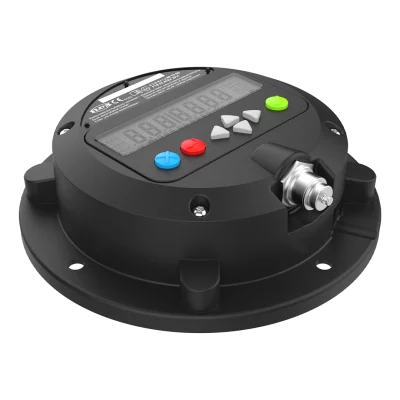
| Measurement Principle | Swashplate | Oval wheel | Turbine wheel | Signal Processing Electronics |
| Flow Rate | 10–250 l/min | 0.04 – 380 l/min | 5–120 l/min | – |
| Max. viscosity | 2,500 mPas | 500,000 mPas | 40 mPas | – |
| Max. operating pressure | 6 bar | 200 bar | 10 bar | – |
| Max. temperature | 80 °C | 120 °C | 50 °C | – |
| Materials | PP, ETFE, stainless steel | PVDF, stainless steel, aluminum | PP | PP |
| Explosion protection | ✓ | ✓ (Stainless steel versions) | – | ✓ (Zone 1) |
| FDA/FOOD | – | ✓ | – | n/a |
| Calibratable |
✓ | ✓ | – | ✓ Calibration based on medium |
| FLUXTRONIC® | ✓ | ✓ | – | ✓ |
| Application | Mobile / Stationary | Mobile / Stationary | Mobile (JUNIORFLUX/COMBIFLUX) | Wall- or product-mounted |
| Ideal for | Changing media, including contaminated media | High-viscosity, pulsating, high-pressure | Small quantities, mobile | Semi-automatic filling |
| FMC | FMO | FMT | FLUXTRONIC® |
The maximum flow rate is a test bench value, measured with water at 20 °C at the pump’s discharge port, without any attachments (hose, dispensing nozzle, flow meter). The flow rate that can be achieved in practice is lower and depends on the specific application, the properties of the fluid, and the pump configuration. Specifications are for an axial rotor, unless otherwise stated.
Downloads
Documents, catalogs, and technical documentation related to FLUX products in one place. select a category to find the documents you're looking for.

Operating Instructions
Operating instructions for all FLUX flow meters.

Data Sheets
Technical specifications, dimensions, and performance data for all FLUX pumps and flow meters.

Performance Curves
Flow rate, head, and performance curves for precise flow meter and pump selection.

Dimension Sheets
Dimensions and installation dimensions for technical planning and design.

Certificates & Evidence
Declarations of conformity, ATEX/IECEx certificates, as well as ISO, REACH, and other certifications.

Brochures
Product brochures and company information to browse and download.
FAQ
Frequently asked questions about FLUX Flow Meters. Types, materials, usage recommendations maintenance and certification.
Yes—both the FMC series and the FMO series are available in explosion-proof versions.
Details:
- FMC: Explosion-proof versions available (see the respective data sheet for details).
- FMO: The S/S versions (stainless steel housing with stainless steel oval impellers) bear the Ex marking II 2G Ex h IIB T4 Gb. Available as FMO 101 S/S, FMO 102 S/S, and FMO 104 S/S.
- FMT: No explosion-proof version available.
When used in potentially explosive atmospheres, the entire system (pump, motor, flow meter, electronics) must be compatible with the respective explosion protection rating.
Products used: FLUX FMC, FLUX FMO
FLUX flow meters are suitable for low-viscosity to high-viscosity fluids—up to 500,000 mPas (FMO) or 2,500 mPas (FMC), depending on the series.
Typical media:
- FMC (tilting-disc): Acids (e.g., formic acid, acetic acid, sulfuric acid up to 98%), alkalis (e.g., sodium hydroxide), glycol, brake fluid, calcium chloride, citric acid, flammable media. Insensitive to small solids.
- FMO (oval impeller): Oils, gasoline, solvents, including non-self-lubricating fluids. For high-viscosity fluids up to 500,000 mPas. Can also be used with pulsating flow rates (e.g., with compressed-air diaphragm pumps).
- FMT (turbine impeller): Neutral, aggressive, low-viscosity, non-flammable liquids up to 40 mPas.
The choice of housing material (PP, PVDF, stainless steel, aluminum, ETFE) depends on the chemical resistance required for the specific medium.
Products Used: FLUX FMC, FLUX FMO, FLUX FMT
FLUX flow meters are designed to require minimal maintenance. Regular visual inspections and cleaning ensure measurement accuracy.
Maintenance Instructions:
- Check regularly for leaks, wear, and deposits.
- For viscous or crystallizing media, flush the meter after use to prevent deposits in the measuring mechanism.
- FMC and FMO models are calibratable—regular calibration is recommended, especially for applications where dosing is critical.
- FMT: As a pure counting unit, it requires very little maintenance.
Products Used: FLUX FMC, FLUX FMO, FLUX FMT
The evaluation depends on the model series and the connected electronics:
- FMC and FMO: When used in combination with the FLUXTRONIC® evaluation electronics, filling and dosing processes can be controlled semi-automatically. In automatic mode, signals can be output for control purposes—such as to activate solenoid valves or for integration into higher-level process control systems.
- FMT: Purely a counting unit—displays the flow rate but offers no evaluation capabilities or signal output.
The FLUXTRONIC® enables preset filling volumes at the push of a button and is suitable for semi-automatic filling systems.
Products Used: FLUX FMC, FLUX FMO, FLUXTRONIC®
FOOD and FDA certifications confirm that the parts of the flow meter that come into contact with the medium are approved for contact with food. FOOD refers to European Regulation (EC) No. 1935/2004, while FDA refers to the U.S. standard CFR 21.
Practical Implications:
- In food, pharmaceutical, and cosmetic applications, certification of the parts in contact with the medium is mandatory.
- Whether a specific model has FOOD or FDA approval can be found in the respective data sheet or certificate.
- The choice of material (e.g., stainless steel, PVDF) affects the approval.
Products used: FLUX FMC, FLUX FMO
Proper installation is crucial for accurate measurement results:
General Installation Instructions:
- Use pressure-resistant, tension-free piping.
- Install the flow meter downstream of the pump (on the pressure side)—stable pressure and uniform flow improve measurement accuracy.
- Always keep the line completely filled with the medium.
- FMC: Operates in any installation position (position-independent).
- FMO: Low pressure loss, calibratable. Follow the installation instructions in the respective dimension sheet.
- FMT: Designed for mobile applications with JUNIORFLUX/COMBIFLUX pumps.
Products used: FLUX FMC, FLUX FMO, FLUX FMT
A flow meter measures the volume of a fluid flowing through a pipe—either as the total volume (meter) or as the current volumetric flow rate (flow per unit of time). FLUX flow meters are used in combination with drum and container pumps or eccentric screw pumps to monitor and control filling and dosing processes.
FLUX offers three series with different measuring principles:
- FMC: Wobble-disc principle – robust, insensitive to solids, 10–250 l/min, up to 2,500 mPas.
- FMO: Oval-wheel principle – high precision, wide measurement range (0.04–380 l/min), up to 500,000 mPas, up to 200 bar.
- FMT: Turbine wheel principle – compact, for mobile applications with JUNIORFLUX/COMBIFLUX, 5–120 l/min.
In combination with the FLUXTRONIC® evaluation electronics, filling and dosing processes can be controlled semi-automatically.
Products used: FLUX FMC, FLUX FMO, FLUX FMT
The maximum operating pressure depends on the series and the housing design:
- FMC (swash plate): up to 6 bar.
- FMO (oval impeller): up to 200 bar – suitable for high-pressure applications.
- FMT (turbine wheel): up to 10 bar.
For high-pressure applications, a pressure-resistant, stress-free installation is required. The FMO is the only series designed for operating pressures above 10 bar.
Products used: FLUX FMC, FLUX FMO, FLUX FMT
FLUX flow meters are available in various material combinations—selected for their chemical resistance to the respective medium.
Housing materials by series:
- FMC (tilting disc): polypropylene (PP), ethylene tetrafluoroethylene (ETFE), stainless steel.
- FMO (oval wheel): Polyvinylidene fluoride (PVDF), stainless steel, aluminum. Oval wheels available in either PPS or stainless steel.
- FMT (turbine wheel): Polypropylene (PP).
The medium temperature influences the choice of material: FMC models can be used up to 80 °C; FMO models made of stainless steel can be used up to 120 °C.
Products used: FLUX FMC, FLUX FMO, FLUX FMT
FLUX offers three measurement principles—each optimized for different media and applications:
- Tumbler Disc Principle (FMC): A disc tumbles inside the housing and displaces a defined volume per revolution. Robust, insensitive to small solids, and can be used in any orientation. For medium flow rates (10–250 l/min) and viscosities up to 2,500 mPas.
- Oval wheel principle (FMO): Two intermeshing oval wheels rotate inside the housing and displace a precise volume with each revolution. Very high measurement accuracy, wide flow rate and viscosity range (0.04–380 l/min, up to 500,000 mPas). Can also be used with pulsating flow streams.
- Turbine-wheel principle (FMT): A turbine wheel rotates in proportion to the flow rate. Compact and easy to handle, designed purely as a metering unit. For low-viscosity fluids (up to 40 mPas) and mobile applications.
The choice of measurement principle depends on viscosity, desired accuracy, and installation conditions.
Products used: FLUX FMC, FLUX FMO, FLUX FMT
FLUX flow meters cover flow rates ranging from 0.04 l/min to 380 l/min—from ultra-low-volume metering to process flow rates.
Measurement ranges by series:
- FMC (tilting-disc): 10–250 l/min, viscosity up to 2,500 mPas, operating pressure up to 6 bar.
- FMO (oval wheel): 0.04–380 l/min, viscosity up to 500,000 mPas, operating pressure up to 200 bar. Various sizes (FMO 101, 102, 104) for different flow ranges.
- FMT (turbine wheel): 5–120 l/min, viscosity up to 40 mPas, operating pressure up to 10 bar.
The FMO covers the widest measurement range and is also suitable for high-viscosity media and high pressures. The FMC is the robust solution for medium flow rates containing solids. The FMT is designed for mobile, low-volume applications.
Products used: FLUX FMC, FLUX FMO, FLUX FMT
For high-viscosity fluids, the FMO series (oval-rotor design) is the right choice—it handles viscosities up to 500,000 mPas.
Details:
- The FMO provides precise measurements even at high viscosities, as the oval-rotor principle operates independently of the fluid’s flowability.
- Can also be used with pulsating flow rates—e.g., in combination with compressed-air diaphragm pumps.
- Operating pressure up to 200 bar, medium temperature up to 120 °C (stainless steel version).
- Low pressure drop even with highly viscous media.
The FMC (up to 2,500 mPas) and FMT (up to 40 mPas) series are not suitable for highly viscous media.
Products used: FLUX FMO
Short answer: The right flow meter ensures precise measurements, process reliability, and lower operating costs. The right FLUX flow meter is selected based on the properties of the fluid, the flow range, and the operating environment. It reliably measures liquids ranging from low-viscosity to high-viscosity and can be integrated into manual or automated processes.
Selecting a flow meter: Answer the following questions and then choose the appropriate flow meter from the FLUX flow meter overview. 1. What do you want to measure? Match media & material compatibility The properties of the medium determine the measuring principle and the materials:
- Flammable or non-flammable?
- Conductive or non-conductive?
- Viscosity: low-viscosity (e.g., water) or high-viscosity (e.g., syrup)?
- Pure or containing particles?
- Chemically aggressive or neutral?
Tip: Choose materials that are chemically resistant to prevent corrosion and failures. 2. How is the fluid conveyed? Check operating conditions Flow range: Does the measurement range match the process? Temperature & pressure: Is the sensor within the permissible range? Pressure loss: Be aware of additional losses due to installation. 3. What are the requirements of the application? Installation & Safety
- Hazardous Area / ATEX: Is the sensor intended for use in a potentially explosive atmosphere?
- Installation: Directly on the pump or in the piping?
4. Do you want to integrate other digital systems?
- Do you need a pulse output, a 4–20 mA signal, or digital interfaces for process control systems?
With FLUXTRONIC®, you can evaluate and document measured values and integrate them into automated processes.
Questions about selecting a flow meter Which flow meter is best for highly viscous media?
- Oval-rotor or wobble-disc flow meters, as these are optimized for viscous liquids.
What should you do with media containing particles?
- Use a wafer-type flow meter or install a filter upstream of oval-wheel flow meters.
How does pressure loss affect the selection?
- For low system pressures, choose a measuring principle with low resistance (e.g., turbine).
What options are available for hazardous areas?
- FLUX offers ATEX-certified devices and compatible evaluation electronics.
Documentation on FLUXTRONIC® evaluation electronics Request a consultation now
Get in touch.
Find documents.

Sales & Advice
Select a pump suitable for the application
We determine the medium, flow rate, viscosity and operating environment.

Requests for quotations
Please send us your requirements
We will assess your requirements and advise you on the most suitable option.

Service & Support
Documents for planning, operation and servicing
Find user manuals, dimension sheets, technical specifications and FAQs.